Spectral Characteristics and Mapping of Rice Fields using Multi-Temporal Landsat and MODIS Data: A Case of District Narowal

Table of contents

1. Introduction

emote sensing dataset offers unique possibilities for spatial and temporal characterization of the changes. The fundamental requirement is the availability of different dates of satellite imagery which permits continuous monitoring of change and environmental developments over time (Lu et al., 2004; Nasr and Helmy, 2009; Ahmad, 2012b; . RS sensor is a key device that captures data about an object or scene remotely. Since objects have their unique spectral features, they can be identified from RS imagery according to their unique spectral characteristics (Xie, 2008; Ahmad and Shafique, 2013; . A good case in vegetation mapping by using RS technology is the spectral radiances in the red and near-infrared (NIR) regions, in addition to others . The radiances in these regions could be incorporated into the spectral vegetation indices (VI) that are directly related to the intercepted fraction of photosynthetically active radiation (Asrar et al., 1984;Galio et al., 1985;Xie, 2008; Ahmad and Shafique, 2013; . The spectral signatures of photosynthetically and nonphotosynthetically active vegetation showed obvious difference and could be utilized to estimate forage quantity and quality of grass prairie (Beeri et al., 2007;Xie, 2008;.

RS is the technology that can give an unbiased view of large areas, with spatially explicit information distribution and time repetition, and has thus been widely used to estimate crop yield and offers great potential for monitoring production, yet the uncertainties associated with large-scale crop yield (Quarmby et al., 1993;Báez-González et al., 2002;Doraiswamy et al., 2003;Ruecker et al., 2007;Ahmad and Shafique, 2013a) estimates are rarely addressed .

RS dataset of better resolution at different time interval helps in analyzing the rate of changes as well as the causal factors or drivers of changes (Dai and Khorram, 1999;Ramachandra and Kumar, 2004;Ahmad, 2012b). Hence, it has a significant role in planning at different spatial and temporal scales. Change detection in agricultural planning helped in enhancing the capacity of local governments to implement sound environmental management (Prenzel and Treitz, 2004;Ramachandra and Kumar, 2004;Ahmad, 2012b). This involves development of spatial and temporal database and analysis techniques. Efficiency of the techniques depends on several factors such as classification schemes, modelling, spatial and (Ramachandra and Kumar, 2004;Ahmad, 2012b). Natural resources in the arid environment are declining in productivity and require special attention, and if the ecological condition persists, a further decline in resources may result in land degradation (Babu et al., 2011).

Preprocessing of satellite datasets prior to vegetation extraction is essential to remove noise (Schowengerdt, 1983; and increase the interpretability of image data (Campbell, 1987;Schowengerdt, 2006;. The ideal result of image preprocessing is that all images after image preprocessing should appear as if they were acquired from the same sensor (Hall et al., 1991;Xie, 2008;. Image preprocessing commonly comprises a series of operations, including but not limited to bad lines replacement, radiometric correction, geometric correction, image enhancement and masking although variations may exist for images acquired by different sensors (Schowengerdt, 1983;Campbell, 1987;Xie, 2008;. Long-term observations of remotely sensed vegetation dynamics have held an increasingly prominent role in the study of terrestrial ecology (Budde et al., 2004;Prasad et al., 2007;Ouyang et al., 2012;Ahmad, 2012a).

The development of long-term data records from multi-satellites/multi-sensors is a key requirement to improve our understanding of natural and humaninduced changes on the Earth and their implications (NRC, 2007; Miura et al., 2008;Ahmad, 2012c). A major limitation of such studies is the limited availability of sufficiently consistent data derived from long-term RS (Ouyang et al., 2012;Ahmad, 2012a;. The benefit obtained from a RS sensor, largely depends on its spectral resolution (Jensen, 2005;Ahmad, 2012a;, which determines the sensor's capability to resolve spectral features of land surfaces (Fontana, 2009;Ahmad, 2012a;. One of the key factors in assessing vegetation dynamics and its response to climate change is the ability to make frequent and consistent observations (Thomas and Leason, 2005;Ouyang et al., 2012;Ahmad, 2012a;.

Landsat ETM+ has shown great potential in agricultural mapping and monitoring due to its advantages over traditional procedures in terms of cost effectiveness and timeliness in availability of information over larger areas (Murthy et al., 1998;Rahman et al., 2004;Adia and Rabiu, 2008;Ahmad, 2012d) and ingredient the temporal dependence of multi-temporal image data to identify the changing pattern of vegetation cover and consequently enhance the interpretation capabilities. Integration of multi-sensor and multitemporal satellite data effectively improves the temporal attribute and the accuracy of results (Adia and Rabiu, 2008;Ahmad, 2012d).

The MODIS (Terra) NDVI (Rouse et al., 1973) and EVI (Liu and Huete, 1995;Justice et al., 1998;Huete et al., 1999) datasets provide unique opportunities for monitoring terrestrial vegetation conditions at regional and global scales (Yang et al., 1997;Piao et al., 2006;Ahmad, 2012a;, and has widely been used in research areas of net primary production (Potter et al., 1993;Paruelo et al., 1997 Multi-year time series of EVI/NDVI can reliably measure yearly-changes in the timing of the availability of high-quality vegetation. The biological significance of NDVI indices should be assessed in various habitat types before they can be widely used in ecological studies (Hamel et al., 2009;Ahmad, 2012a). The premise is that the NDVI is an indicator of vegetation health, because degradation of ecosystem vegetation, or a decrease in green, would be reflected in a decrease in NDVI value (Hamel et al., 2009;Meneses-Tovar, 2011;Ahmad, 2012a). The NDVI has the potential ability to signal the vegetation features of different eco-regions and provides valuable information as a RS tool in studying vegetation phenology cycles at a regional scale (Guo, 2003;Ahmad, 2012a).

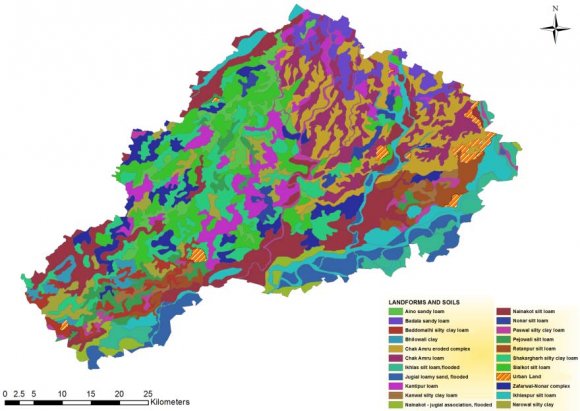
The NDVI is established to be highly correlated to green-leaf density and can be viewed as a proxy for above-ground biomass (Tucker and Sellers, 1986;Ahmad, 2012e). The NDVI is the most commonly used index of greenness derived from multispectral RS data (USGS, 2010; Ahmad, 2012e), and is used in several studies on vegetation, since it has been proven to be positively correlated with density of green matter (Townshend et al., 1991;Huete et al., 1997;Huete et al., 2002;Debien et al., 2010;Ahmad, 2012e). The NDVI provides useful information for detecting and interpreting vegetation land cover it has been widely used in RS studies (Dorman and Sellers, 1989;Myneni and Asrar, 1994;Gao, 1996 The District Narowal (Figure 1; 2) lies in the Punjab province of Pakistan from 31° 55' to 32° 30' North latitude and 74° 35' to 75° 21' East longitude. The district is bounded on the north-west by Sialkot district, on the north by Jammu State, on the east by Gurdaspur district (India) and on the south by Amritsar district (India) and Sheikhupura district (GOP, 2000). The general aspect of the district is a plain slopping down from the uplands at the base of the Himalayas to the level country to the south-west (Figure 3), and the general altitude is 266 meters above sea level (GOP, 2000;Shah, 2007).

Bounded on the south-east by the river Ravi, the district is fringed on the either side by a line of fresh alluvial soil, about which rise the low banks that form the limits of the river bed. At about a distance of 24 km from Ravi, another stream, the Dake which rises in the Jammu hills traverses the district. The district is practically a level plain. Its north-eastern boundary is at a distance of about 32 km from the outer line of the Himalayas, but the foot-hills stop short of the district and its surface is level plain broken only by the river Ravi, by more than drainage channels. The general slope as indicated by the lines of drainage is from north-east to south-west (GOP, 2000). inclusion into a categorization algorithm as an input feature (Ozdogan et al., 2010). Using dataset from multiple time periods, the prejudice procedure is based on the different spectral responses of crops according to their phenological evolution (Abuzar et al., 2001;Ozdogan et al., 2010). A number of studies have established that using spectral information from two successive seasons in a crop-year is sufficient to identify the paddy/rice fields. However, for each season, the estimates require multiple datasets (Abuzar et al., 2001;Ozdogan et al., 2006;Ozdogan et al., 2010). This is because single-date analysis in visible cropping intensity often does not take into account planting dates that vary from year to year. Therefore, multi-temporal analysis has greater potential to define paddy/rice fields (Akbari et al., 2006;Ozdogan et al., 2010). Eventually, the results of classification are restricted upon the temporal and spatial variability of the spectral signature of the land cover type in question, so suitable datasets The use of the NDVI would comprise direct II.

2. Research Design and Methods

must be available for the temporal approach to provide a complete inventory of all crops (Ozdogan et al., 2010).

RS studies of vegetation normally use specific wavelengths selected to provide information about the vegetation present in the area from which the radiance data emanated. These wavelength regions are selected because they provide a strong signal from the vegetation and also have a spectral contrast from most background resources (Tucker and Sellers, 1986). The wavelength region located in the VIS-NIR transition has been shown to have high information content for vegetation spectra (Collins, 1978;Horler et al., 1983;Broge and Leblanc, 2000). The spectral reflectance of vegetation in this region is characterized by very low reflectance in the red part of the spectrum followed by an abrupt increase in reflectance at 700-740 nm wavelengths (Broge and Leblanc, 2000). This spectral reflectance pattern of vegetation is generally referred to as the 'red edge'. The red edge position is likewise well correlated with biophysical parameters at the canopy level, but less sensitive to spectral noise caused by the soil background and by atmospheric effects Demetriades-Shah et al., 1990;Guyot et al., 1992;Mauser and Bach, 1994;Broge and Leblanc, 2000).

Leaf water content governs the reflectance properties beyond 1000 nm, but has practically no effect on the spectral properties in the VIS and NIR regions (Broge and Leblanc, 2000). In fact, chlorophyll concentration was sufficient to absorb nearly all of the blue and red radiation. Reflectance in the green (550 nm) and red-edge (715 nm) bands increase significantly as chlorophyll concentration decrease (Daughtry et al., 2000). Variations of leaf dry matter content affects canopy reflectance by increasing or decreasing the multiple intercellular scattering of the NIR rays. However, for practical RS applications, this effect can be assumed to be negligible, because within-crop variations of leaf dry matter content is very stable (Broge and Leblanc, 2000). Soil compaction negatively affects crop growth characteristics (Lowery and Schuler, 1991 The MODIS has been supplying a continuous data stream since 2000, lending to comprehensive time series analysis of the global terrestrial environment (Grogan and Fensholt, 2013). Of the available POES datasets, the MODIS reflectance products are favored among many in the research community with a focus on monitoring regional to global vegetation dynamics. The MODIS has a number of advantages when compared to other moderate-to-course resolution sensors, including superior spatial resolution, a broad spectral range (visible to mid-infrared), and superior geolocational accuracy (Wolfe et

3. III.

4. Results

The vegetation phenology is important for predicting ecosystem carbon, nitrogen, and water fluxes (Baldocchi et The NDVI has been widely used for vegetation monitoring primarily for its simplicity. It is conceived as the normalized difference between the minimum peak of reflectance in the red wavelength and the maximum reflectance in the NIR domain: the higher the index value the better the vegetation conditions in terms of both biomass amount and vegetation health (Daughtry et al., 2000;Haboudane et al., 2002;Stroppiana et al., 2006).

Vegetation extraction from satellite imagery is the process of extracting vegetation information by interpreting satellite images based on the interpretation elements and association information (Xie, 2008 2.

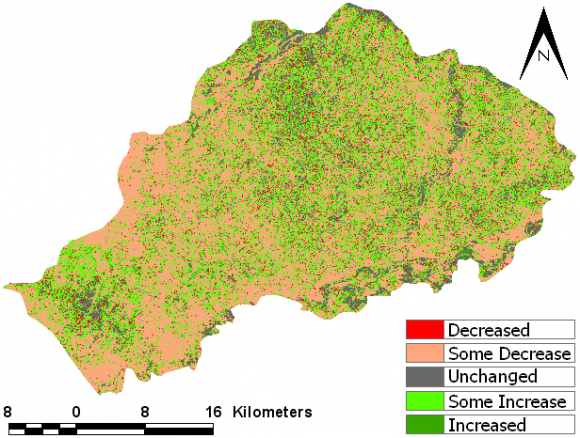
Figure 5 shows classified NDVI 2010, Narowal. After rectification, the NDVI model was applied upon Landsat TM image acquired on 2 nd November, 2010. ArcGIS symbology tool was used to develop NDVI classes and recognize the paddy cropped areas in Narowal. Maximum NDVI, minimum NDVI, mean NDVI and standard deviation is given in Table 2. Figure 8 shows image difference or change detection (2001-2010) at Narowal. The findings showed that decreased was 1254.83 km 2 (48.73%), some decrease 840.27 km 2 (32.64%), unchanged was 133.95 km 2 (5.20%), some increase 336.37 km 2 (13.06%) while increased was 9.58 km 2 (0.37%). Decreased and some decrease in vegetation cover was much higher as compared to some increase and increased. Accuracy assessment is given in the Table 5.

Detection of change is the measure of the distinct data framework and thematic change information that can direct to more tangible insights into underlying process involving land cover and land-use changes (Singh et al., 2013;. Monitoring the locations and distributions of land cover changes is important for establishing links between policy decisions, regulatory actions and subsequent land-use activities (Lunetta et al., 2006; Volume XIV Issue VI Version I 6; Figure 21) to investigate the general trend. Linear forecast trendline showed that fractional yield at Naina Kot was smooth during the entire period. The findings showed that January 2003 was the driest month during the entire period; February 2000 to February 2013. Heavy amount of fertilizer was used for crop growth and soil productivity.

IV.

5. Discussion and Conclusions

RS datasets and techniques have already proven to be relevant to many requirements of crop inventory and monitoring (Haboudane et al., 2002). At the present, there is an increased interest in precision farming and the development of smart systems for agricultural resource management; these relatively new approaches aim to increase the productivity, optimize the profitability, and protect the environment. In this context, image-based RS technology is seen as a key tool to provide valuable information that is still lacking or inappropriate to the achievement of sustainable and efficient agricultural practices (Moran et al., 1997;Daughtry et al., 2000;Haboudane et al., 2002).

RS provides a key means of measuring and monitoring phenology at continental to global scales and vegetation indices derived from satellite data are now commonly used for this purpose (Nightingale et al., 2008;Tan et al., 2008;Ahmad, 2012a;2012f). The study also identified several data acquisition and processing issues that warrant further investigation. Studies are under way to assess the importance of coordinating and timing field data collection and image acquisition dates as a means of improving the strength of the relationships between image and land condition trend analysis (Senseman et al., 1996;Ahmad, 2012c) ground-truth data. Recent literature has shown that the narrow bands may be crucial for providing additional information with significant improvements over broad bands in quantifying biophysical characteristics of paddy/rice crop (Thenkabail et al., 2000).

RS of agricultural resources is based on the measurement of the electromagnetic energy reflected or emitted from the Earth surface as a result of the energy matter interaction. RS data interpretation and processing aim to derive vegetation biophysical properties from its spectral properties (Stroppiana et al., 2006).

Spectral-based change detection techniques have tended to be performance limited in biologically complex ecosystems due, in larger part, to phenologyinduced errors (Lunetta et al., 2002;Lunetta et al., 2002a;Lunetta et al., 2006;). An important consideration for land cover change detection is the nominal temporal frequency of remote sensor data acquisitions required to adequately characterize change events (Lunetta et al., 2004;Lunetta et al., 2006;. Ecosystem-specific regeneration rates are important considerations for determining the required frequency of data collections to minimize errors. As part of the natural processes associated with vegetation dynamics, plants undergo intra-annual cycles. During different stages of vegetation growth, plants' structure and associated pigment assemblages can vary significantly (Lunetta et al., 2006;.

Validation is a key issue in RS based studies of phenology over large areas (Huete, 1999;Schwartz and Reed, 1999;Zhang et al., 2003;Ahmad, 2012d). While a variety of field programs for monitoring phenology have been initiated (Schwartz, 1999;Zhang et al., 2003;Ahmad, 2012d), these programs provide data that is typically specie-specific and which is collected at scales that are not compatible with coarse resolution RS observations.

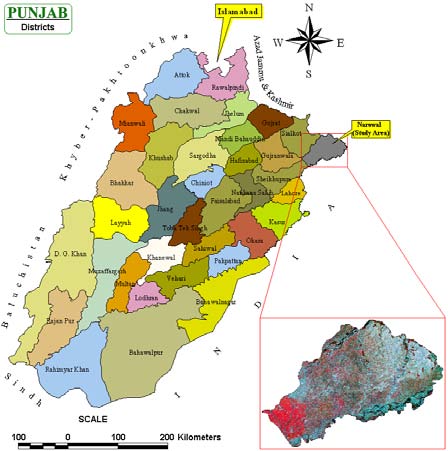
Figure 1. Figure 1 :
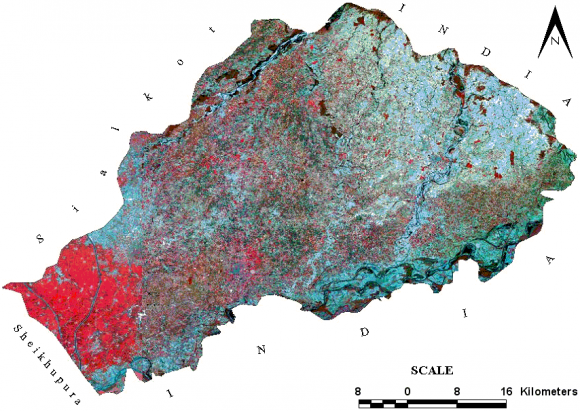
1Figure 1 : Location Map of the Study Area
Figure 2. Figure 2 :
2Figure 2 : Narowal -Landsat ETM+ 30 th September, 2001 image Source: http://glovis.usgs.gov/
Figure 3. Figure 3 :
3Figure 3 : Landforms and Soils, Narowal District
Figure 4.
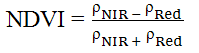
; Kulkarni and Bajwa, 2005; Ahmad et al., 2013), yield (Johnson et al., 1990; Kulkarni and Bajwa, 2005; Ahmad et al., 2013), and root distribution and development (Taylor and Gardner, 1963; Unger and Kaspar, 1994; Kulkarni and Bajwa, 2005; Ahmad et al., 2013). However, bare soil reflectance may be affected by the impact of tillage practices and moisture content (Barnes et al., 1996; Kulkarni and Bajwa, 2005; Ahmad et al., 2013). The wavelengths detected as responsive to soil compaction were close to each other, they might had similar information about the vegetation vigor. In the red portion of spectrum, the wavelengths ranged from 620 to 700 nm (Thenkabail et al., 2000; Kulkarni and Bajwa, 2005; Ahmad et al., 2013). The NDVI assumed the most common vegetation index used throughout the history of satellite canopy background adjustment that addresses nonlinear, differential NIR and red radiant transfer through a canopy, and C1, C2 are the coefficients of the aerosol resistance term, which uses the blue band to correct for aerosol influences in the red band. The coefficients adopted in the EVI algorithm are; L=1, C1 = 6, C2 = data applications. The NDVI represents the absorption of photosynthetic active radiation and hence is a measurement of the photosynthetic capacity of the canopy (Rouse et al., 1973; Woomer et al., 2004). The NDVI is computed following the equation: Where, ? NIR and ? Red are the surface bidirectional reflectance factors for their respective MODIS bands. The NDVI is referred to as the 'continuity index' to the existing 20+ year NOAA-AVHRR derived NDVI (Rouse et al., 1973; Ahmad, 2012c) time series (Moran et al., 1992; Verhoef et al., 1996; Jakubauskas et al., 2001; Huete et al., 2002; Zoran and Stefan, 2006; USGS, 2010; Ahmad, 2012c), which could be extended by MODIS data to provide a longer term data record for use in operational monitoring studies (Chen et al., 2003; Ahmad, 2012c). The NDVI has been established to be highly correlated to green-leaf density, absorbed fraction of photosynthetically active radiation and above-ground biomass and can be viewed as a surrogate for photosynthetic capability (Asrar et al., 1984; Tucker and Sellers, 1986; Propastin and Kappas, 2009). The NDVI values range from -1 to +1; because of high reflectance in the NIR portion of the EMS, healthy vegetation is represented by high NDVI values between 0.1 and 1 (Liu and Huete, 1995; USGS, 2008; 2010; Ahmad, 2012a; Ahmad et al., 2013). On the contrary, non-vegetated surfaces such as water bodies yield negative values of NDVI because of the electromagnetic absorption property of water. Bare soil areas represent NDVI values which are closest to 0 due to high reflectance in both the visible and NIR portions of the EMS (Townshend, 1992; Ahmad, 2012a; Ahmad et al., 2013). The EVI is an 'optimized index' designed to enhance the vegetation signal with improved sensitivity in high biomass regions and improved vegetation monitoring through a de-coupling of the canopy background signal and a reduction in atmosphere influences (Liu and Huete, 1995; Justice et al., 1998; Huete et al., 1999; Ahmad, 2012c). The EVI is computed following the equation: Where NIR/RED/Blue are atmosphericallycorrected or partially atmosphere corrected (Rayleigh and ozone absorption) surface reflectances, L is the 7.5, and G (gain factor) = 2.5 (Liu and Huete, 1995; Justice et al., 1998; Huete et al., 1999; Huete et al., 2002; Karnieli and Dall'Olmo, 2003; Huete, 2005; Gao and Mas, 2008; Ahmad, 2012c).
Figure 5.
over time (Ayman and Ashraf, 2009; Ahmad and Shafique, 2013). The EVI/NDVI pixel values were used to calculate fractional yield (Shinners and Binversie, 2007; Ahmad et al., 2013) from February, 2000 to February, 2013. The NDVI pixel values showed theoretical yield and EVI pixel values showed actual yield. The fractional yield is computed following the equation: Phenology is the study of the times of recurring natural phenomena. One of the most successful of the approach is based on tracking the temporal change of a vegetation index such as NDVI or EVI. The evolution of vegetation index exhibits a strong correlation with the typical green vegetation growth stages. The results (temporal curves) can be analyzed to obtain useful information such as the start/end of vegetation growing season (Gao and Mas, 2008; Ahmad, 2012a; 2012b; Ahmad and Shafique, 2013). Vegetation phenology derived from RS is important for a variety of applications (Hufkens et al., 2010; Ahmad, 2012b). Vegetation phenology can provide a useful signal for classifying vegetated land cover (Dennison and Roberts, 2003; Ahmad, 2012b). Changes in vegetation spectral response caused by phenology can conceal longer term changes in the landscape (Hobbs, 1989; Lambin, 1996; Dennison and Roberts, 2003; Ahmad, 2012b). Multi-temporal data that captures these spectral differences can improve reparability of vegetation types over classifications based on single date imagery (DeFries et al., 1995; Ahmad, 2012b).
Figure 6. Figure 4
4Figure 4 shows classified NDVI 2001, Narowal.After rectification, the NDVI model was applied upon Landsat ETM+ image acquired on 30 th September, 2001. ArcGIS symbology tool was used to develop NDVI classes and recognize the paddy cropped areas in Narowal. Maximum NDVI, minimum NDVI, mean NDVI and standard deviation is given in Table2.Figure5shows classified NDVI 2010, Narowal. After rectification, the NDVI model was applied upon Landsat TM image acquired on 2 nd November, 2010. ArcGIS symbology tool was used to develop NDVI classes and recognize the paddy cropped areas in Narowal. Maximum NDVI, minimum NDVI, mean NDVI and standard deviation is given in Table2.
Figure 7. Figure 4 :Figure 5 :
45Figure 4 : Classified NDVI 2001, Narowal
Figure 8. Figure 6 :
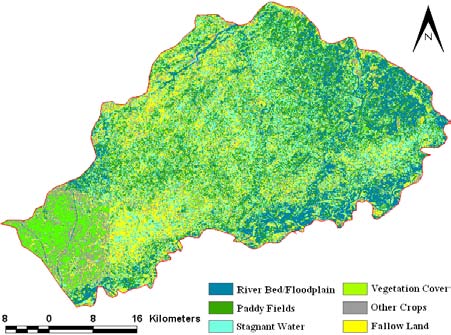
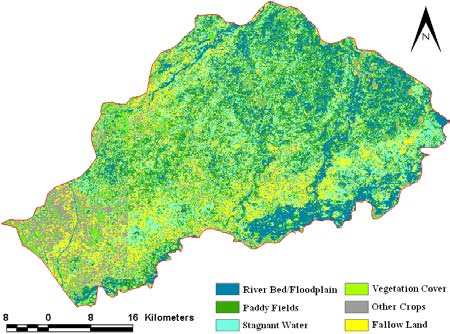
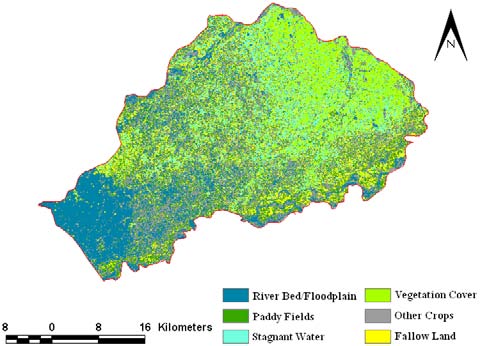
6Figure 6 : Supervised Classification 2001 Figure 7 : Supervised Classification 2010
Figure 9. Figure 7
7Figure 7 shows supervised classification 2010, Narowal. The classification was applied upon Landsat TM image acquired on 2 nd November, 2010. The findings showed that the river bed/floodplain covered the area of 481.90 km 2 (18.71%), paddy fields 400.14 vegetation cover 320.48 km 2 (12.45%), fallow land 546.16 km 2 (21.22%) while other crops covered the area of 467.01 km 2 (18.14%). Accuracy assessment is given in the Table4.
Figure 10. Figure 8 :
8Figure 8 : Image Difference (2001-2010) at Narowal
Figure 11.
Human Social Science © 2014 Global Journals Inc. (US) -Spectral Characteristics and Mapping of Rice Fields using Multi-Temporal Landsat and MODIS Data: A Case of District Narowal km 2 (15.53%), stagnant water 359.31 km 2 (13.95%), Ahmad and Shafique, 2013). Change detection as defined by Hoffer (1978) is temporal effects as variation in spectral response involves situations where the spectral characteristics of the vegetation or other cover type in a given location change over time. Singh (1989) described change detection as a process that observes the differences of an object or phenomenon at different times (Adia and Rabiu, 2008; Ahmad and Shafique, 2013). Accurate assessment of vegetation response across multiple-year time scales is crucial for analyses of global change (Running and Nemani, 1991; Sellers et al., 1994; Stow, 1995; Justice et al., 1998; Fensholt, 2004; Baugh and Groeneveld, 2006; Ahmad, 2012c), effects of human activities (Moran et al., 1997; Milich and Weiss 2000; Thiam, 2003; Baugh and Groeneveld, 2006; Ahmad, 2012c) and ecological relationships (Baret and Guyot, 1991; Asrar et al., 1992; Begue, 1993; Epiphanio and Huete, 1995; Gillies et al., 1997; Baugh and Groeneveld, 2006; Ahmad, 2012c).
Figure 12. Figure 9 :
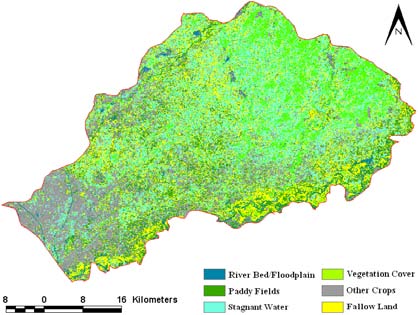
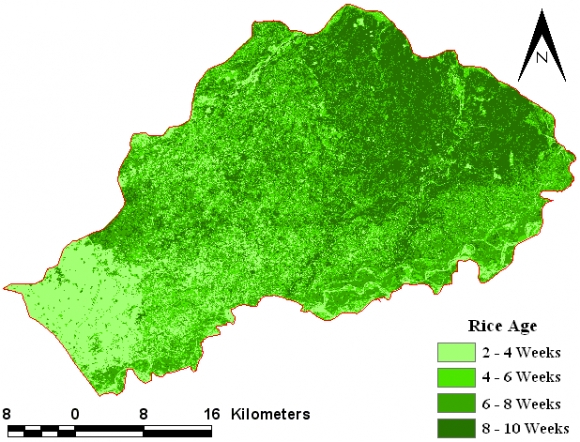
9Figure 9 : Paddy/rice fields distribution map of Narowal from the analysis of Landsat ETM+ image
Figure 13. Figure 9
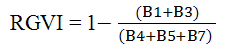
9Figure 9 shows paddy/rice fields distribution map of Narowal from the analysis of Landsat ETM+ image using the following Rice Growth Vegetation Index (RGVI) model. In Narowal, especially in early transplanting periods, water environment plays an important role in rice spectral (Nuarsa et al., 2011; Nuarsa et al., 2012). The blue band of Landsat ETM+ has good sensitivity to the existence of water; therefore, the development of RGVI used the B1, B3, B4, and B5 of Landsat ETM+ with the following equation (Nuarsa et al., 2011):
Figure 14. Figure 10
10Figure 10 shows time-series phenology metrics for Bara Manga district Narowal. In this profile MODIS (Terra) EVI/NDVI 250 m data products for the period February 2000 to February 2013 at 16-days interval was evaluated. The NDVI value in February 2000 (start) was 0.79 and the NDVI value in February 2013 (end) was 0.66 while EVI pixel value in February 2000 (start) was 5835 and in February 2013 (end) was 3786. The maximum NDVI value (0.87) was recorded in February 2007 while minimum NDVI value (0.05) was in January 2003. The trend analysis (NDVI) showed no change during the entire period. The phenological profile showed the paddy crop growth stages (transplanting to maturity and further ripening) at Bara Manga. The fluctuations in the phenological profile were due to variation in the temperature-precipitation. Variations in vegetation activity have been linked with changes in climates (Los et al., 2001; Tucker et al., 2001; Zhou et al., 2001; 2003; Lucht et al., 2002; Piao et al., 2003; Ahmad, 2012a).
Figure 15. Figure 10 :
10Figure 10 : Time series phenology metrics for Bara Manga Processed by the author Figure 11 shows time-series phenology metrics for Becochak district Narowal. The NDVI value in February 2000 (start) was 0.57 and NDVI value in February 2013 (end) was 0.62; EVI pixel value in February 2000 (start) was 3287 and in February 2013 (end) was 3306. The maximum NDVI value (0.85) was recorded in July 2011 while the minimum NDVI value (0.05) was in January 2003. Liu and Huete (1995) integrated atmospheric resistance and background effects in NDVI to enhance vegetation signals in high biomass regions and proposed EVI (Ahmad, 2012c).
Figure 16. Figure 11 :
11Figure 11 : Time series phenology metrics for Becochak Processed by the author Figure 12 shows time-series phenology metrics for Boora Dala district Narowal. The NDVI value in February 2000 (start) was 0.53 and the NDVI value in February 2013 (end) was 0.63 while EVI pixel value in February 2000 (start) was 3375 and in February 2013 (end) was 3441. The maximum NDVI value (0.79) was recorded in March 2011 while minimum NDVI value (0.04) was in January 2003. The EVI differs from NDVI because of endeavor to differentiate atmospheric and background effects (Ahmad, 2012b). The EVI is better to categorize little differences in dense vegetative areas, where NDVI showed saturation (Ahmad and Shafique, 2013).
Figure 17. Figure 12 :
12Figure 12 : Time series phenology metrics for Boora Dala
Figure 18. Figure 13 :
13Figure 13 : Time series phenology metrics for Budha Dhola Processed by the author Figure 14 shows time-series phenology metrics for Fattu Chak district Narowal. The NDVI value in February 2000 (start) was 0.46 and the NDVI value in February 2013 (end) was 0.66 while EVI pixel value in February 2000 (start) was 3433 and in February 2013 (end) was 4140. The maximum NDVI value (0.81) was recorded in March 2007 while minimum NDVI value (0.04) was in January 2003. The evolution of vegetation index exhibits a strong correlation with the typical green vegetation growth stages (Zhao et al., 2005; Ahmad,2012d). The results (temporal curves) can be analyzed to obtain useful information such as the start/end of vegetation growing season. However, RS based phenological analysis results are only an approximation of the true biological growth stages. This is mainly due to the limitation of current space based RS, especially the spatial resolution, and the nature of vegetation index. A pixel in an image does not contain a pure target but a mixture of whatever intersected the sensor's field of view(Gao and Mas, 2008;Ahmad, 2012d).
Figure 19. Figure 14 :
14Figure 14 : Time series phenology metrics for Fattu Chak Processed by the author Figure 15 shows time-series phenology metrics for Gumtala district Narowal. The NDVI value in February 2000 (start) was 0.38 and the NDVI value in February 2013 (end) was 0.58 while EVI pixel value in February 2000 (start) was 2453 and in February 2013 (end) was 3450. The maximum NDVI value (0.70) was recorded in August 2011 while minimum NDVI value (0.04) was in January 2003. The NDVI can be used not only for accurate description of vegetation classification and vegetation phenology (Tucker et al., 1982; Tarpley et al., 1984; Justice et al., 1985; Lloyd, 1990; Singh et al., 2003; Los et al., 2005; Ahmad, 2012a) but also effective for monitoring rainfall and drought, estimating net primary production of vegetation, crop growth conditions and crop yield, detecting weather impacts and other events important for agriculture and ecology(Glenn, 2008).
Figure 20. Figure 15 :
15Figure 15 : Time series phenology metrics for Gumtala
Figure 21. Figure 16 :
16Figure 16 : Time series phenology metrics for Lalian Processed by the author Figure 17 shows time-series phenology metrics for Naina Kot district Narowal. The NDVI value in February 2000 (start) was 0.80 and the NDVI value in February 2013 (end) was 0.66 while EVI pixel value in February 2000 (start) was 3524 and in February 2013 (end) was 3576. The maximum NDVI value (0.83) was recorded in September 2005 while minimum NDVI value (0.05) was in January 2003. The NDVI suppresses differential solar illumination effects of slope and aspect orientation (Lillesand and Kiefer, 1994; Sader et al., 2001; Ahmad and Shafique, 2013a) and helps to normalize differences in brightness values when processing multiple dates of imagery (Singh, 1986; Lyon et al., 1998; Sader et al., 2001; Ahmad and Shafique, 2013a).
Figure 22. Figure 17 :
17Figure 17 : Time series phenology metrics for Naina Kot Processed by the author Figure 18 shows time-series phenology metrics for Nathoo Kot district Narowal. The NDVI value in February 2000 (start) was 0.60 and the NDVI value in February 2013 (end) was 0.77 while EVI pixel value in February 2000 (start) was 3944 and in February 2013 (end) was 5073. The maximum NDVI value (0.78) was recorded in March 2012 while minimum NDVI value (0.05) was in January 2003. RS provides a key means of measuring and monitoring phenology at continental to global scales and vegetation indices derived from satellite data are now commonly used for this purpose (Nightingale et al., 2008; Tan et al., 2008; Ahmad, 2012e; Ahmad, 2012f). Changes in the phenological events may therefore signal important year-to-year climatic variations or even global environmental change (Botta et al., 2000; Jolly et al., 2005; Hashemi, 2010; Ahmad, 2012e; Ahmad, 2012f).
Figure 23. Figure 18 :
18Figure 18 : Time series phenology metrics for Nathoo Kot
Figure 24. Figure 19 :
19Figure 19 : Time series phenology metrics for Pherowal Processed by the author Figure 20 shows time-series phenology metrics for Talwandi Bhindran district Narowal. The NDVI value in February 2000 (start) was 0.65 and the NDVI value in February 2013 (end) was 0.37 while EVI pixel value in February 2000 (start) was 4620 and in February 2013 (end) was 1722. The maximum NDVI value (0.79) was recorded in March 2005 while minimum NDVI value (0.04) was in January 2003. The NDVI is the most commonly used of all the VIs tested and its performance, due to non-systematic variation as described by Huete and Liu (1994) and Liu and Huete (1995). The soil background is a major surface component controlling the spectral behaviour of vegetation (Ahmad and Shafique, 2013). Although vegetation indices, such as the soil-adjusted (Huete, 1988) vegetation indices, considerably reduce these soils effects, estimation of the vegetation characteristics from the indices still suffers from some imprecision, especially at relatively low cover, if no information about the target is known (Rondeaux et al., 1996; Ahmad and Shafique, 2013).
Figure 25. Figure 20 :
20Figure 20 : Time series phenology metrics for Talwandi Bhindran Processed by the author
Figure 26. Figure 21 :
21Figure 21 : Linear forecast trendline for the dataset of Naina Kot Linear forecast trendline was plotted upon the fractional yield dataset of Naina Kot (Table6; Figure21) to investigate the general trend. Linear forecast trendline showed that fractional yield at Naina Kot was smooth during the entire period. The findings showed that January 2003 was the driest month during the entire period; February 2000 to February 2013. Heavy amount of fertilizer was used for crop growth and soil productivity.
Figure 27.
Figure 28.
; Sesnie et al., 2008;
Karaburun, 2010; Ahmad, 2012f; Ahmad and Shafique,
2013a; Ahmad et al., 2013).
The NDVI is chlorophyll sensitive; the EVI (Liu
and Huete, 1995;
Figure 29. Table 1 :
1
The MODIS (Terra) EVI/NDVI (MOD13Q1) data
products for research area were acquired, in this case
data were downloaded from the Land Processes
Distributed Active Archive Center (LPDAAC). Tile
number covering this area is h24v05, reprojected from
the Integerized Sinusoidal projection to a Geographic
Lat/Lon projection, and Datum WGS84 (GSFC/NASA,
2003; Ahmad, 2012a; 2012b; Ahmad et al., 2013). A
gapless time series of MODIS (Terra) EVI/NDVI
composite raster data from February, 2000 to February,
2013 with a spatial resolution of 250 m (Table 1) was
utilized for calculation of the rice fractional yield. The
datasets provide frequent information at the spatial
scale at which the majority of human-driven land cover
changes occur (Townshend and Justice, 1988;
Verbesselt et al., 2010; Ahmad, 2012a; Ahmad et al.,
2013). MODIS products are designed to provide
consistent spatial and temporal comparisons between
different global vegetation conditions that can be used
to monitor photosynthetic activity and forecast crop
yields (Vazifedoust et al., 2009; Cheng and Wu, 2011;
Ahmad et al., 2013). Details documenting the MODIS
(Terra) EVI/NDVI compositing process and Quality
Assessment Science Data Sets can be found at NASA's
MODIS web site (MODIS, 1999; USGS, 2008; Ahmad et
al., 2013). This study explored the suitability of the
MODIS (Terra) EVI/NDVI (MOD13Q1) pixels obtained
from a paddy/rice cultivated area, Naina Kot over
thirteen years (February, 2000 to February, 2013), to
explore rice fractional yield (Mulianga et al., 2013).
Figure 30.
The application of the NDVI (Rouse et al., 1973;
Tucker, 1979; Ahmad, 2012a) in ecological studies has
enabled quantification and mapping of green vegetation
with the goal of estimating above ground net primary
productivity and other landscape-level fluxes (Wang et
al., 2003; Pettorelli et al., 2005; Aguilar et al., 2012;
Ahmad, 2012a).
Figure 31. Table 2 :
2
Image Acquisition Date Maximum NDVI Minimum NDVI Mean NDVI Standard Deviation
30 th September, 2001 (Landsat ETM+) 0.56 -0.42 0.05 0.11
2 nd November, 2010 (Landsat TM) 0.65 -0.40 0.13 0.11
Figure 32. Table 3 :
3
Image Acquisition Date Classes Area (km 2 ) Area (%) Accuracy Assessment (%)
River Bed/Floodplain 498.69 19.37 87.42
Paddy Fields 430.88 16.73 85.44
30 th September, 2001 (Landsat ETM+) Stagnant Water Vegetation Cover Other Crops 382.97 294.12 565.24 14.87 11.42 21.95 87.08 88.45 92.20
Fallow Land 403.10 15.66 87.29
SUM 2575 100 -
Figure 6 shows supervised classification 2001, of 565.24 km 2 (21.95%). Accuracy assessment is given
Narowal. The classification was applied upon Landsat in the
ETM+ image acquired on 30 th September, 2001. The
findings showed that the river bed/floodplain covered
the area of 498.69 km 2 (19.37%), paddy fields 430.88
vegetation cover 294.12 km 2 (11.42%), fallow land
403.10 km 2 (15.66%) while other crops covered the area
Figure 33. Table 3 .
3
Year 2014
42
( B )
Global Journal of Human Social Science
Note: © 2014 Global Journals Inc. (US) km 2 (16.73%), stagnant water 382.97 km 2 (14.87%),
Figure 34. Table 4 :
4
Image Acquisition Date Classes Area (km 2 ) Area (%) Accuracy Assessment (%)
River Bed/Floodplain 481.90 18.71 87.02
Paddy Fields 400.14 15.53 88.04
2 nd November, 2010 (Landsat TM) Stagnant Water Vegetation Cover Other Crops 359.31 320.48 467.01 13.95 12.45 18.14 92.04 85.42 90.20
Fallow Land 546.16 21.22 87.09
SUM 2575 100 -
Figure 35. Table 5 :
5
During 2001 to 2010
Classes Area (km 2 ) Area (%) Accuracy Assessment
(%)
Decreased 1254.83 48.73 87.31
Some Decrease 840.27 32.64 90.19
Unchanged 133.95 5.20 87.22
Some Increase 336.37 13.06 85.79
Increased 9.58 0.37 92.14
SUM 2575 100 -
Figure 36. Table 6 :
6
Image EVI NDVI Fractional Image EVI NDVI Fractional
Acquisition Pixel Pixel Yield Acquisition Pixel Pixel Yield
(Month/Year) Value Value (%) (Month/Year) Value Value (%)
Feb. 2000 3524 8008 44.01 Feb. 2007 4061 7586 53.53
May 2000 1775 2289 77.54 May 2007 1590 2557 62.18
Aug. 2000 3516 7839 44.85 Aug. 2007 4531 7971 56.84
Nov. 2000 1411 2874 49.10 Nov. 2007 1585 3025 52.40
Feb. 2001 2363 6118 38.62 Feb. 2008 3564 7055 50.52
May 2001 1677 2332 71.91 May 2008 1602 2447 65.47
Aug. 2001 3847 6021 63.89 Aug. 2008 2607 7832 33.29
Nov. 2001 1687 3317 50.86 Nov. 2008 1984 3079 64.44
Feb. 2002 3415 6524 52.35 Feb. 2009 4595 6857 67.01
May 2002 1782 1957 91.06 May 2009 1491 2121 70.30
Aug. 2002 3988 7373 54.09 Aug. 2009 4786 7202 66.45
Nov. 2002 1904 3596 52.95 Nov. 2009 1485 3416 43.47
Feb. 2003 3506 7671 45.70 Feb. 2010 3510 6422 54.66
May 2003 1669 1707 98.12 May 2010 1205 2068 58.27
Aug. 2003 4981 8101 61.49 Aug. 2010 4740 7610 62.29
Nov. 2003 1699 3922 43.32 Nov. 2010 1816 3405 53.33
Feb. 2004 4858 7968 60.97 Feb. 2011 3994 6968 57.32
May 2004 2133 1792 119.03 May 2011 1602 1961 81.70
Aug. 2004 4214 8057 52.30 Aug. 2011 2929 7303 40.08
Nov. 2004 1937 4090 47.36 Nov. 2011 1951 3409 57.23
Feb. 2005 2863 7701 37.18 Feb. 2012 3559 5639 63.11
May 2005 1684 2324 61.82 May 2012 1206 2283 52.83
Aug. 2005 3252 7920 41.06 Aug. 2012 4804 7263 66.14
Nov. 2005 1497 3240 46.20 Nov. 2012 1500 3205 46.80
Feb. 2006 3481 7309 47.63 Feb. 2013 3576 6584 54.31
May 2006 1578 2434 64.83
Aug. 2006 2441 7710 31.66
Nov. 2006 1907 3292 57.93
1
2

Appendix A

  1. , Remote Sensing of Environment 59 p. .
  2. , 10.1109/IGARSS.2008.4779447. July, 2008. Boston, Massachusetts, U.S.A..
  3. Leaf area index, intercepted photosynthetically active radiation, and spectral vegetation indices: A sensitivity analysis for regular-clumped canopies. A Begue . Remote Sensing of Environment 1993. 46 p. .
  4. A global prognostic scheme of leaf onset using satellite data. A Botta , N Viovy , P Ciais , P Friedlingstein , P Monfray . Global Change Biology 2000. 6 (7) p. .
  5. Using satellite and field data with crop growth modeling to monitor and estimate corn yield in Mexico. A D Báez-González , P Y Chen , M Tiscareño-López , R Srinivasan . Crop Science 2002. 42 (6) p. .
  6. Influence of satellite-derived rainfall patterns on plague occurrence in northeast Tanzania. A Debien , S Neerinckx , D Kimaro , H Gulinck . International Journal of Health Geographics 2010. 9 p. .
  7. Influence of spring phenology on seasonal and annual carbon balance in two contrasting New England forests. A D Richardson , D Y Hollinger , D B Dail , J T Lee , J W Munger , J O'keefe . Tree Physiology 2009. 29 (3) p. .
  8. Integration of Misrsat-1 and SPOT-2 data for quantitative change detection applications. A H Nasr , A K Helmy . http://www.icgst.com/gvip/volume9/Issue5/GVIP_V9_I5.pdf. ICGST-GVIP Journal 2009. 2011. 9 (5) p. . (Accessed on November 04)
  9. Land resource inventory and agricultural land use plan of Narowal district. National Agricultural Land use Plan (Project), Soil Survey of Pakistan, A H Shah . 2007. Lahore, Pakistan.
  10. Estimation of C factor for soil erosion modeling using NDVI in Büyükçekmece watershed. A Karaburun . Ozean Journal of Applied Sciences 2010. 3 (1) p. .
  11. Remotesensing monitoring of desertification, phenology, and droughts. A Karnieli , G Dall'olmo . An International Journal 2003. 14 (1) p. . (Management of Environmental Quality)
  12. Inter-annual variability of vegetation cover and rainfall over India. A K Prasad , S Sudipta , R P Singh , M Kafatos . Advances in Space Research 2007. 39 (1) p. .
  13. Hydrological assessment and modelling of the river Fani catchment. A Nicandrou . http://dspace1.isd.glam.ac.uk/dspace/handle/10265/461 Albania. Faculty of Advanced Technology 2010. November 11. 2012. University of Glamorgan
  14. Multiple effects of urbanization on the biodiversity of developing countries: The case of a fast-growing metropolitan area. A Pauchard , M Aguayo , E Peña , R Urrutia . Biological Conservation 2006. 127 p. .
  15. A soil adjusted vegetation index (SAVI), A R Huete . 1988. 25 p. . (Remote Sensing of Environment)
  16. An error and sensitivity analysis of the atmospheric-and soilcorrecting variants of the NDVI for the MODIS-EOS. A R Huete , H Q Liu . IEEE Transactions on Geoscience and Remote Sensing 1994. 32 p. .
  17. A comparison of vegetation indices over a global set of TM images for EOS-MODIS, A R Huete , H Q Liu , K Batchily , Van W Leeuwen . 1997.
  18. MODIS vegetation index (MOD 13) algorithm theoretical basis document version 3, A R Huete , C O Justice , Van W Leeuwen . http://modis.gsfc.nasa.gov/data/atbd/atbd_mod13.pdf 1999. 2011. 17. (Accessed on September)
  19. Overview of the radiometric and biophysical performance of the MODIS vegetation indices. A R Huete , K Didan , T Miura , E P Rodriguez , X Gao , L G Ferreira . Remote Sensing of Environment 2002. 83 (1-2) p. .
  20. Global variability of terrestrial surface properties derived from MODIS visible to thermal-infrared measurements. A R Huete . http://ieeexplore.ieee.org/iel5/10226/32601/01526 Proceedings of IGARSS 05 Geoscience and Remote Sensing Symposium, (IGARSS 05 Geoscience and Remote Sensing Symposium) 2005. July 2005. p. .
  21. Change detection in the tropical forest environment of northeastern India using Landsat remote sensing and tropical land management: Remote Sensing and, A Singh . Tropical Land Management. Eden, M.J. and Perry, J.T. (ed.) 1986. New York: John Wiley & Sons, Inc. p. .
  22. Digital change detection techniques using remotely sensed data. A Singh . International Journal of Remote Sensing 1989. 10 (6) p. .
  23. Land use and land cover change detection: a comparative approach using post classification change matrix and discriminate function change detection methodology of Allahabad city. A Singh , S Singh , P K Garg , K Khanduri . International Journal of Current Engineering and Technology 2013. 3 (1) p. .
  24. Assessing the effect of climate change on honey bees using scale hive records and satellite derived vegetation phenology products, http://www.igarss08.org/Abstracts/pdfs/2282.pdf 2011. 10.
  25. The causes and spatial pattern of land degradation risk in southern Mauritania using multitemporal AVHRR-NDVI imagery and field data. A Thiam . Land Degradation & Development 2003. 14 p. .
  26. NDWI -A normalized difference water index for remote sensing of vegetation liquid water from space. B-C Gao . Remote Sensing of Environment 1996. 58 (3) p. .
  27. , B C Reed , J F Brown , D Vanderzee , T R Loveland , J W Merchant , D O Ohlen . 1994.
  28. Remote sensing change detection of irrigated agriculture in Afghanistan. B Haack , J Wolf , R English . Geocarto International 1998. 13 (2) p. .
  29. Relationship between vegetation indices, radiation absorption, and net photosynthesis evaluated by sensitivity analysis. B J Choudhury . Remote Sensing of Environment 1987. 22 p. .
  30. Temporal effects of subsoil compaction on soil strength and plant growth. B Lowery , R T Schuler . Soil Science Society of America Journal 1991. 55 (1) p. .
  31. Forecasting regional sugarcane yield based on time integral and spatial aggregation of MODIS NDVI. B Mulianga , A Bégué , M Simoes , P Todoroff . Remote Sensing 2013. 5 p. .
  32. Remote sensing change detection for a watershed in north Sulawesi. B Prenzel , P Treitz . Indonesia. Progress in Planning 2004. 61 p. .
  33. Vegetation phenology metrics derived from temporally smoothed and gap-filled MODIS data, B Tan , J T Morisette , R E Wolfe , F Gao , G A Ederer , J M Nightingale , J A Pedelty . URL:www.igarss08.org/Abstracts/pdfs/2347.pdf. 2008. 2011. 10. (Accessed on November)
  34. NDVI as an indicator for changes in water availability to woody vegetation. C Aguilar , J C Zinnert , M J Polo , D R Young . Ecological Indicators 2012. 23 p. .
  35. Rapid loss of Paraguay's Atlantic forest and the status of protected areas: A Landsat assessment. C Huang , S Kim , A Altstatt , J R G Townshend , P Davis , K Song , C J Tucker , O Rodas , A Yanosky , R Clay , J Musinsky . Remote Sensing of Environment 2007. 106 p. .
  36. Red and photographic infrared linear combinations for monitoring vegetation. C J Tucker . Remote Sensing of Environment 1979. 8 (2) p. .
  37. Monitoring large scale vegetation dynamics in the Nile delta and river valley from NOAA AVHRR data. C J Tucker , J Gatlin , S R Schnieder , M A Kuchinos . Proceedings of the Conference on Remote Sensing of Arid and Semi-Arid Lands, (the Conference on Remote Sensing of Arid and Semi-Arid LandsCairo, Egypt
    ) 1982. p. .
  38. Satellite remote sensing of primary production. C J Tucker , P J Sellers . International Journal of Remote Sensing 1986.
  39. Expansion and contraction of the Sahara Desert from 1980 to. C J Tucker , H E Dregne , W W Newcomb . Science 1991. 1990. 253 p. .
  40. Higher northern latitude normalized difference vegetation index and growing season trends from 1982 to 1999. C J Tucker , D A Slayback , J E Pinzon , S O Los , R B Myneni , M G Taylor . International Journal of Biometeorology 2001. 45 (4) p. .
  41. C L Meneses-Tovar . NDVI as indicator of degradation. Unasylva, 2011. 62 p. .
  42. Analysis of the phenology of global vegetation using meteorological satellite data. C O Justice , J R G Townshend , B N Holben , C J Tucker . International Journal of Remote Sensing 1985. 6 p. .
  43. The Moderate Resolution Imaging Spectroradiometer (MODIS): Land remote sensing for global change research. C O Justice , E Vermote , J R G Townshend , R S Defries , D P Roy , D K Hall , V V Salomonson , J Privette , G Riggs , A Strahler , W Lucht , R Myneni , Y Knjazihhin , S Running , R Nemani , Z Wan , A R Huete , W Leeuwen , R E Wolfe , L Giglio , J.-P Muller , P Lewis , M Barnsley . IEEE Transactions on Geoscience and Remote Sensing 1998. 36 (4) p. .
  44. Estimating corn leaf chlorophyll concentration from leaf and canopy reflectance. C S T Daughtry , C L Walthall , M S Kim , E B Colstoun , Iii Mcmurtrey , JE . Remote Sensing of Environment 2000. 74 (2) p. .
  45. Satellite derived crop calendar for canal operation schedule in Bhadra project command area. C S Murthy , P V Raju , S Jonna , K A Hakeem , S Thiruvengadachari . India. International Journal of Remote Sensing 1998. 19 (15) p. .
  46. Terrestrial ecosystem production, a process model based on global satellite and surface data. C S Potter , J T Randerson , C B Field , P A Matson , P M Vitousek , H A Mooney , S A Klooster . Global Biogeochemical Cycles 1993. 7 p. .
  47. Generation of action plans for sustainable agriculture development for rain shadow regions using GIS technology. D B S Babu , P K Tummalapalli , V M Rao , I V Muralikrishna . International Journal of Earth Sciences and Engineering 2011. 4 (6) p. .
  48. Remote sensing of regional crop production in the Yaqui Valley, Mexico: Estimates and uncertainties. Agriculture. D B Lobell , G P Asner , J I Ortiz-Monasterio , T L Benning . Ecosystems and Environment 2003. 94 p. .
  49. Predicting the onset of net carbon uptake by deciduous forests with soil temperature and climate data: a synthesis of FLUXNET data. D D Baldocchi , T A Black , P S Curtis , E Falge , J D Fuentes , A Granier , L Gu , A Knohl , K Pilegaard , H P Schmid , R Valentini , K Wilson , S Wofsy , L Xu , S Yamamoto . International Journal of Biometeorology 2005. 49 p. .
  50. Integrated narrow-band vegetation indices for prediction of crop chlorophyll content for application to precision agriculture. D Haboudane , J R Miller , N Tremblay , P J Zarco-Tejada , L Dextraze . Remote Sensing of Environment 2002. 81 (2-3) p. .
  51. A phenological classification of terrestrial vegetation cover using shortwave vegetation index imagery. D Lloyd . International Journal of Remote Sensing 1990. 11 (12) p. .
  52. Change detection techniques. D Lu , P Mausel , E Brondizios , E Moran . International Journal of Remote Sensing 2004. 25 (12) p. .
  53. The red edge of plant leaf reflectance. D N H Horler , M Dockray , J Barber . International Journal of Remote Sensing 1983. 4 (2) p. .
  54. Dunefield activity response to climate variability in the southwest Kalahari. D S G Thomas , H C Leason . Geomorphology 2005. 64 (1-2) p. .
  55. Monitoring ecosystem response to global change: Multitemporal remote sensing analyses, D Stow . Moreno, J. and Oechel, W. (ed.) 1995. New York: Springer-Verlag. p. . (Anticipated Effects of a Changing Global Environment in Mediterranean Type Ecosystems)
  56. Remotely sensed estimation of rice nitrogen concentration for forcing crop growth models. D Stroppiana , M Boschetti , P A Brivio , S Bocchi . Italian Journal of Agrometeorology 2006. 3 p. .
  57. Automated update of an irrigated lands GIS using SPOT HRV imagery. D W Eckhardt , J P Verdin , G R Lyford . Photogrammetric Engineering & Remote Sensing 1990. 56 p. .
  58. Earth Resources Observation and Science Center. http://glovis.usgs.gov USGS 2008. September 09. 2013.
  59. Earth Science and Applications from Space: National Imperatives for the Next Decade and Beyond. National Research Council of the National Academies. http://www.nap.edu/openbook.php?record_id=11820&page=428. NRC 2007. 2011. The National Academies Press. 17 p. 428. (Accessed on September)
  60. Change detection at multiple temporal scales -seasonal and annual variations in landscape variables. E F Lambin . Photogrammetric Engineering & Remote Sensing 1996. 62 (8) p. .
  61. MODIS surface reflectance User's Guide. MODIS Land Surface Reflectance Science Computing Facility, E F Vermote , S Y Kotchenova , J P Ray . 2011. NASA, College Park, MD, USA. p. .
  62. Multispectral remote sensing and site-specific agriculture: Examples of current technology and future possibilities. E M Barnes , M S Moran , Jr P J Pinter , T R Clarke . Proceedings of the 3rd International Conference on Precision Agriculture, (the 3rd International Conference on Precision AgricultureMinneapolis, Minnesota, USA
    ) 1996. June 1996. p. .
  63. Relationship between remotelysensed vegetation indices, canopy attributes and plant physiological processes: What vegetation indices can and cannot tell us about the landscape. E P Glenn , A R Huete , P L Nagler , S G Nelson . Sensors 2008. 8 p. .
  64. Pixel Purity Index algorithm and n-Dimensional Visualization for ETM+ image analysis: A case of District Vehari. F Ahmad . Global Journal of Human Social Science: Arts and Humanities 2012. 12 (15) p. .
  65. Phenologically-tuned MODIS NDVI-based time series. F Ahmad . Global Journal of Human Social Science: Geography & Environmental Geo-Sciences 2012a. 2000-2012. 12 (13) p. .
  66. A review of remote sensing data change detection: Comparison of Faisalabad and Multan Districts. F Ahmad . Journal of Geography and Regional Planning 2012b. 5 (9) p. .
  67. Spectral vegetation indices performance evaluated for Cholistan Desert. F Ahmad . Journal of Geography and Regional Planning 2012c. 5 (6) p. .
  68. Landsat ETM+ and MODIS EVI/NDVI data products for climatic variation and agricultural measurements in Cholistan Desert. F Ahmad . Global Journal of Human Social Science: Geography & Environmental Geo-Sciences 2012d. 12 (13) p. .
  69. NOAA AVHRR NDVI/MODIS NDVI predicts potential to forest resource management in Çatalca district of Turkey. F Ahmad . Global Journal of Science Frontier Research: Environment & Earth Sciences 2012e. 12 (3) p. .
  70. NOAA AVHRR satellite data for evaluation of climatic variation and vegetation change in the Punjab Province. F Ahmad . Pakistan. Journal of Food, Agriculture & Environment 2012f. 10 (2) p. .
  71. Detection of change in vegetation cover using multi-spectral and multi-temporal information for District Sargodha. F Ahmad , K Shafique . Global Journal of Human Social Sciences: Geography & Environmental Geo-Sciences 2013. 13 (1) p. .
  72. The utilization of MODIS and Landsat TM/ETM+ for cotton fractional yield estimation in Burewala. F Ahmad , K Shafique , S R Ahmad , S.-Ur Rehman , R M A Khan , A Raoof . Global Journal of Human Social Science: Geography, Geo-Sciences, Environmental Disaster Management 2013. 13 (7) p. .
  73. Land degradation pattern using geo-information technology for Kot Addu. F Ahmad , K Shafique . Global Journal of Human Social Sciences: Geography & Environmental Geo-Sciences 2013a. 13 (1) p. . (Version 1.0)
  74. Potentials and limits of vegetation indices for LAI and APAR assessment. F Baret , G Guyot . Remote Sensing of Environment 1991. 35 p. .
  75. Modeled analysis of the biophysical nature of spectral shifts and comparison with information content of broad bands. F Baret , S Jacquemoud , G Guyot , C Leprieur . Remote Sensing of Environment 1992. 41 (2-3) p. .
  76. Radiometric rectification: Toward a common radiometric response among multi-date, multi-sensor images. F G Hall , D E Strebel , J E Nickeson , S J Goetz . Remote Sensing of Environment 1991. 35 p. .
  77. From single pixel to continental scale: using AVHRR and MODIS to study land surface parameters in mountain regions, F M A Fontana . http://www.climatestudies.unibe.ch/students/theses/phd/31.pdf.(AccessedonOctober15 2009. 2012. Switzerland. Institute of Geography, University of Bern (Ph.D. dissertation)
  78. The influence of climate and dam construction on the Iberá wetlands. G A Canziani , R M Ferrati , C Rossi , D Ruiz-Moreno . Argentina. Regional Environmental Change 2006. 6 p. .
  79. Estimating absorbed photosynthetic radiation and leaf area index from spectral reflectance in wheat. G Asrar , M Fuch , E T Kanemasu . Agronomy Journal 1984. 76 p. .
  80. Spatial heterogeneity in vegetation canopies and remote sensing of absorbed photosynthetically active radiation: A modeling study. G Asrar , R B Myneni , B J Choudhury . Remote Sensing of Environment 1992. 41 p. .
  81. Longterm satellite NDVI datasets: Evaluating their ability to detect ecosystem functional changes in South America. G Baldi , M D Nosetto , R Aragón , F Aversa , J M Paruelo , E G Jobbágy . Sensors 2008. 8 p. .
  82. Land use and land cover dynamics in South American temperate Grasslands. G Baldi , J M Paruelo . http://www.ecologyandsociety.org/vol13/iss2/art6/(Accessedon Ecology and Society 2008. January 11. 2012. 13 (2) .
  83. Imaging spectroscopy for vegetation studies. G Guyot , F Baret , S Jacquemoud . Imaging spectroscopy: Fundamentals and prospective applications, F Toselli, J Bodechtel (ed.) (Dordrecht
    ) 1992. Kluwer Academic Press. p. .
  84. Correlation of rangeland cover measures to satellite-imagery-derived vegetation indices. G M Senseman , C F Bagley , S A Tweddale . Geocarto International 1996. 11 (3) p. .
  85. Mapping irrigated cropland from Landsat data for determination of water use from the high plains aquifer in parts of Colorado. G P Thelin , F J Heimes . US Geological Survey Professional Paper 1987.
  86. Optimization of soil-adjusted vegetation indices. G Rondeaux , M Steven , F Baret . Remote Sensing of Environment 1996. 55 p. .
  87. Cotton yield estimation in Uzbekistan integrating MODIS, Landsat ETM+ and field data, G R Ruecker , Z Shi , M Mueller , C Conrad , N Ibragimov , J P A Lamers , C Martius , G Strunz , S W Dech . http://www.isprs.org/proceedings/XXXVI/8-W48/123_XXXVI-8-W48.pdf 2007. January 20. 2013. p. .
  88. Gsfc/Nasa . http://modis.gsfc.nasa.gov/about/specs.html MODIS technical specifications, 2003. September 05, 2011.
  89. Digital change detection using remotely sensed data for monitoring green space destruction in Tabriz. H Mahmoodzadeh . International Journal of Environmental Research 2007. 1 (1) p. .
  90. Penetration of cotton seedlings tap roots as influenced by bulk density, moisture content and strength of soil. H M Taylor , H R Gardner . Soil Science 1963. 96 p. .
  91. Integration of Misrsat-1 and SPOT-2 data for quantitative change detection applications. H N Ayman , K H Ashraf . ICGST-GVIP Journal 2009. 9 (5) p. .
  92. A feedback based modification of the NDVI to minimize canopy background and atmospheric noise. H Q Liu , A R Huete . IEEE Transactions on Geoscience and Remote Sensing 1995. 33 (2) p. .
  93. Agriculture expansion and deforestation in seasonally dry forests of north-west Argentina. H R Grau , N I Gasparri , T M Aide . Environmental Conservation 2005. 32 p. .
  94. H Romero , F Ordenes . Emerging urbanization in the Southern Andes: and Development, 2004. 24 p. .
  95. , I A El-Magd , T W Tanton . International Journal of Remote Sensing 2003. 24 p. .
  96. Spectral characterization of rice field using multi-temporal Landsat ETM+ data. I W Nuarsa , S Kanno , Y Sugimori , F Nishio . International Journal of Remote Sensing and Earth Sciences 2005. 2 p. .
  97. Spectral characteristics and mapping of rice plants using multi-temporal Landsat data. I W Nuarsa , F Nishio , C Hongo . Journal of Agricultural Science 2011. 3 (1) p. .
  98. Using variance analysis of multitemporal MODIS images for rice field mapping in Bali Province. I W Nuarsa , F Nishio , C Hongo , I G Mahardika . Indonesia. International Journal of Remote Sensing 2012. 33 (17) p. .
  99. Monitoring land-cover changes: a comparison of change detection techniques. J-F Mas . International Journal of Remote Sensing 1999. 20 (1) p. .
  100. Introduction to remote sensing, J B Campbell . 1987. New York: The Guilford Press. p. 281.
  101. Dependence of NDVI and SAVI on sun/sensor geometry and its effect on fPAR relationships in Alfalfa. J C N Epiphanio , A R Huete . Remote Sensing of Environment 1995. 51 p. .
  102. Predicting the effects of climate change on water yield and forest production in the northeastern United States. J D Aber , S V Ollinger , C A Federer , P B Reich , M L Goulden , D W Kicklighter , J M Melillo , R G Lathrop . Climate Research 1995. 5 p. .
  103. Remote sensing estimates of boreal and temperate forest woody biomass, carbon pools, sources and sinks. J Dong , R K Kaufmann , R B Myneni , C J Tucker , P E Kauppi , J Liski , W Buermann , V Alexeyev , M K Hughes . Remote Sensing of Environment 2003. 84 p. .
  104. Global vegetation indices from NOAA-7 meteorological satellite. J D Tarpley , S R Schnieder , R L Money . Journal of Climate and Applied Meteorology 1984. 23 p. .
  105. Soybean growth and yield as affected by surface and subsoil compaction. J F Johnson , W B Voorhees , W W Nelson , G W Randall . Agronomy Journal 1990. 82 (5) p. .
  106. A change detection experiment using vegetation indices. J G Lyon , D Yuan , R S Lunetta , C D Elvidge . Photogrammetric Engineering & Remote Sensing 1998. 64 (2) p. .
  107. A Global climatology of albedo, roughness length and stomatal resistance for atmospheric general circulation models as represented by the simple biosphere model (SiB). J L Dorman , P J Sellers . Journal of Applied Meteorology 1989. 28 p. .
  108. , J M Nightingale , W E Esaias , R E Wolfe , J E Nickeson , J A Pedelty . 2008.
  109. ANPP estimates from NDVI for the Central Grassland Region of the United States. J M Paruelo , H E Epstein , W K Lauenroth , I C Burke . Ecology 1997. 78 (3) p. .
  110. Detecting and predicting spatial and interannual patterns of temperate forest springtime phenology in the eastern U. J P Jenkins , B H Braswell , S E Frolking , J D Aber . S. Geophysical Research Letters 2002. 29 (24) p. .
  111. Selecting the spatial-resolution of satellite sensors required for global monitoring of land transformations. J R G Townshend , C O Justice . International Journal of Remote Sensing 1988. 9 (2) p. .
  112. Global land cover classification by remote sensing: present capabilities and future possibilities. J R G Townshend , C O Justice , W Li , C Gurney , J Mcmanus . Remote Sensing of Environment 1991. 35 (2-3) p. .
  113. Improved global data for land applications: A proposal for a new high resolution data set. J R G Townshend . http://library.wur.nl/WebQuery/clc/916308.(Accessedon International Geosphere-Biosphere Program 1992. June 04. 2012. 20. (Report)
  114. Introductory digital image processing: A remote sensing perspective, J R Jensen . 2005. (3rd)
  115. Phenological change detection while accounting for abrupt and gradual trends in satellite image time series. J Verbesselt , R Hyndman , A Zeileis , D Culvenor . Remote Sensing of Environment 2010. 114 (12) p. .
  116. Temporal responses of NDVI to precipitation and temperature in the central Great Plains, USA. J Wang , P M Rich , K P Price . International Journal of Remote Sensing 2003. 24 p. .
  117. Monitoring vegetation systems in the Great Plains with ERTS. 3rd ERTS Symposium, NASA SP-351 I, J W Rouse , R H Haas , J A Schell , D W Deering . http://geol.hu/data/online_help/Vegetation_Indices.html 1973. January 10. 2012. p. .
  118. The identification of irrigated crop types and estimation of acreages from Landsat imagery. K E Kolm , H L Case . Photogrammetric Engineering & Remote Sensing 1984. 50 p. .
  119. Exploring patterns and effects of aerosol quantity flag anomalies in MODIS surface reflectance products in the tropics. K Grogan , R Fensholt . Remote Sensing 2013. 5 p. .
  120. Vegetation phenology from MODIS/AVHRR/ PhenoCam: Scaling and validation possibilities, K Hufkens , M A Friedl , A D Richardson , T Milliman , M Migliavacca . http://modis.gsfc.nasa.gov/sci_team/meetings/201001/presentations/posters/land/hufkens.pdf 2010. 2011. 10.
  121. Fractional yield and moisture of corn stover biomass produced in the Northern US Corn Belt. K J Shinners , B N Binversie . Biomass and Bioenergy 2007. 31 p. .
  122. Remotely sensed vegetation phenology for describing and predicting the biomes of South Africa. K J Wessels , K Steenkamp , G Maltitz , S Archibald . Applied Vegetation Science 2011. 14 (1) p. .
  123. Hyperspectral mixture modeling for quantifying sparse vegetation cover in arid environments. K Mcgwire , T Minor , L Fenstermaker . Remote Sensing of Environment 2000. 72 (3) p. .
  124. Measurement of irrigated acreage in Western Kansas from LANDSAT images. K M Keene , C D Conley . Environmental Geology 1980. 3 (2) p. .
  125. Spectral estimation of absorbed photosynthetically active radiation in corn canopies. K P Galio , C S T Daughtry , M E Bauer . Agronomy Journal 1985. 78 p. .
  126. Vegetation indices derived from remote sensing for an estimation of soil protection against water erosion. L Cyr , F Bonn , A Pesant . Ecological Modelling 1995. 79 (1-3) p. .
  127. Review of hyperspectral remote sensing and vegetation science. L Kumar , K S Schmidt , S Dury , A K Skidmore . Imaging spectrometry: Basic Principles and Prospective Applications, Meer, F D Van Der, S M Jong (ed.) (Dordrecht
    ) 2001. Kluwer Academic Press. p. .
  128. GAC NDVI interannual coefficient of variation (CoV) images: Ground truth sampling of the Sahel along northsouth transects. L Milich , E Weiss . International Journal of Remote Sensing 2000. 21 p. .
  129. Variations in northern vegetation activity inferred from satellite data of vegetation index during 1981 to 1999. L M Zhou , C J Tucker , R K Kaufmann , D Slayback , N V Shabanov , R B Myneni . Journal of Geophysical Research 2001. 106 p. .
  130. Relation between interannual variations in satellite measures of northern forest greenness and climate between 1982 and 1999. L M Zhou , R K Kaufmann , Y Tian , R B Myneni , C J Tucker . Journal of Geophysical Research 2003. 108 (D1) p. p.
  131. Classification of seasonal images for monitoring irrigated crops in a salinity-affected area of Australia. M Abuzar , A Mcallister , M Morris . International Journal of Remote Sensing 2001. 22 (5) p. .
  132. Crop and land cover classification in Iran using Landsat 7 imagery. M Akbari , A R Mamanpoush , A Gieske , M Miranzadeh , M Torabi , H R Salemi . International Journal of Remote Sensing 2006. 27 (19) p. .
  133. Change detection of winter crop coverage and the use of Landsat data with GIS. Md R Rahman , A H M H Islam , Md S Hassan . The Journal of Geo-Environment 2004. 4 p. .
  134. Advancing to full bloom: Planning phenological research for the 21st century. M D Schwartz . International Journal of Biometeorology 1999. 42 (3) p. .
  135. Surface phenology and satellite sensor-derived onset of greenness: An initial comparison. M D Schwartz , B C Reed . International Journal of Remote Sensing 1999. 20 (17) p. .
  136. Measuring phenological variability from satellite imagery. Journal of Vegetation Science 5 (5) p. .
  137. Assessing land cover performance in Senegal, West Africa using 1-km integrated NDVI and local variance analysis. M E Budde , G Tappan , J Rowland , J Lewis , L L Tieszen . Journal of Arid Environments 2004. 59 (3) p. .
  138. Harmonic analysis of time-series AVHRR NDVI data. M E Jakubauskas , D R Legates , J H Kastens . Photogrammetric Engineering & Remote Sensing 2001. 67 (4) p. .
  139. Crop identification using harmonic analysis of time-series AVHRR NDVI data. M E Jakubauskas , R David , J H Kastens . Computers and Electronics in Agriculture 2002. 37 (1-3) p. .
  140. Detecting seasonal changes in a semi-arid environment using hyperspectral vegetation indices. M Frank , G Menz . Proceedings of 3rd EARSel Workshop on Imaging Spectroscopy, (3rd EARSel Workshop on Imaging SpectroscopyHerrschingen, Germany
    ) 2003. May 2003. p. .
  141. Monitoring vegetation change in Abu Dhabi Emirate from 1996 to 2000 and 2004 using Landsat satellite imagery. M J Starbuck , J Tamayo . Arab Gulf Journal of Scientific Research 2007. 25 (1-2) p. .
  142. MODIS Vegetation Index (MOD 13): Algorithm theoretical basis document pp. http://modis.gsfc.nasa.gov/data/atbd/atbd_mod13.pdf. MODIS 1999. 2008. (3) p. . (Accessed on December 04)
  143. Changes in summer irrigated crop area and water use in southeastern Turkey from 1993 to 2002: Implications for current and future water resources. M Ozdogan , C E Woodcock , G D Salvucci , H Demir . Water Resources Management 2006. 20 p. .
  144. A new methodology to map irrigated areas using multitemporal MODIS and ancillary data: An application example in the continental US. M Ozdogan , G Gutman . Remote Sensing of Environment 2008. 112 p. .
  145. Remote sensing of irrigated agriculture: Opportunities and challenges. M Ozdogan , Y Yang , G Allez , C Cervantes . Remote Sensing 2010. 2 p. .
  146. The status of agricultural lands in Egypt: The use of multitemporal NDVI features derived from Landsat TM. M Pax-Lenney , C E Woodcock , J B Collins , H Hamdi . Remote Sensing of Environment 1996. 56 p. .
  147. Evaluation of simplified procedures for retrieval of land surface reflectance factors from satellite sensor output. M S Moran , R D Jackson , P N Slater , P M Teillet . Remote Sensing of Environment 1992. 41 (2-3) p. .
  148. Opportunities and limitations for image-based remote sensing in precision crop management. M S Moran , Y Inoue , E M Barnes . Remote Sensing of Environment 1997. 61 (3) p. .
  149. Assimilation of satellite data into agrohydrological models to improve crop yield forecasts. M Vazifedoust , J C Van Dam , W G M Bastiaanssen , R A Feddes . International Journal of Remote Sensing 2009. 30 (10) p. .
  150. Improvements of the MODIS terrestrial gross and net primary production global data set. M Zhao , F A Heinsch , R R Nemani , S Running . Remote Sensing of Environment 2005. 95 p. .
  151. Climatic changes effects on spectral vegetation indices for forested areas analysis from satellite data. M Zoran , S Stefan . Proceedings of the 2 nd Environmental Physics Conference, (the 2 nd Environmental Physics ConferenceAlexandria, Egypt
    ) 2006. 18-22 February 2006. p. .
  152. The use of multi-temporal NDVI measurements from AVHRR data for crop yield estimation and prediction. N A Quarmby , M Milnes , T L Hindle , N Silleos . International Journal of Remote Sensing 1993. 14 p. .
  153. , Netherlands Springer . Environmental Monitoring and Assessment 119 (1-3) p. .
  154. Comparing prediction power and stability of broadband and hyperspectral vegetation indices for estimation of density. N H Broge , E Leblanc . Remote Sensing of Environment 2000. 76 (2) p. .
  155. Using the satellite-derived NDVI to assess ecological responses to environmental change. N Pettorelli , J O Vik , A Mysterud , J M Gaillard , C J Tucker , N C Stenseth . Trends in Ecology & Evolution 2005. 20 (9) p. .
  156. Estimating forage quantity and quality using aerial hyperspectral imagery for northern mixed-grass prairie. O Beeri , R Phillips , J Hendrickson . Remote Sensing of Environment 2007. 110 p. .
  157. Crop conditions and yield simulations using Landsat and MODIS. P C Doraiswamy , J L Hatfield , T J Jackson , B Akhmedov , J Prueger , A Stern . Remote Sensing of Environment 2003. 92 p. .
  158. The effects of vegetation phenology on endmember selection and species mapping in southern California chaparral. P E Dennison , D A Roberts . Remote Sensing of Environment 2003. 87 (2-3) p. .
  159. Carbon stocks in Senegal's Sahel transition zone. P L Woomer , A Touré , M Sall . Journal of Arid Environments 2004. 59 (3) p. .
  160. Irrigated crops monitoring through seasons using digital change detection analysis of IRS-LISS 2 data. P Manavalan , K Kesavasamy , S Adiga . International Journal of Remote Sensing 1995. 16 (4) p. .
  161. Deforestation in Brazilian Amazonia: History, rates, and consequences. P M Fearnside . Conservation Biology 2005. 19 p. .
  162. Population Census Organization, Statistic Division, Government of Pakistan. GOP 2000. 1998. p. . (District census report of Narowal)
  163. Modeling net ecosystem exchange for grassland in central Kazakhstan by combining remote sensing and field data. P Propastin , M Kappas . Remote Sensing 2009. 1 p. .
  164. Why use hyperspectral imagery? Photogrammetric Engineering & Remote Sensing, P Shippert . http://www.iro.umontreal.ca/~mignotte/IFT6150/ComplementCours/HyperspectralImagery.pdf.(Accessedon 2004. November 20. 2011. p. .
  165. Hyperspectral vegetation indices and their relationships with agricultural crop characteristics. P S Thenkabail , R B Smith , E Pauw , De . Remote Sensing of Environment 2000. 71 (2) p. .
  166. Ganges and Indus river basin land use/land cover (LULC) and irrigated area mapping using continuous streams of MODIS data. P S Thenkabail , M Schull , H Turral . Remote Sensing of Environment 2005. 95 p. .
  167. Irrigated area maps and statistics of India using remote sensing and national statistics. P S Thenkabail , V Dheeravath , C M Biradar , O R P Gangalakunta , P Noojipady , C Gurappa , M Velpuri , M Gumma , Y Li . Remote Sensing 2009. 1 p. .
  168. Soil compaction and root growth: A review. P W Unger , T C Kasper . Agronomy Journal 1994. 86 (5) p. .
  169. Assessment of NDVI composite using merged NOAA-14 and NOAA-15 AVHRR data. P Y Chen , R Srinivasan , G Fedosejevs , A D Báez-González , P Gong . Geographic Information Sciences 2002. 8 (1) p. .
  170. Evaluating different NDVI composite techniques using NOAA-14 AVHRR data. P Y Chen , R Srinivasan , G Fedosejevs , J R Kiniry . International Journal of Remote Sensing 2003. 24 p. .
  171. Assessment of MODIS-EVI, MODIS-NDVI and VEGETATION-NDVI composite data using agricultural measurements: An example at corn fields in western Mexico, P Y Chen , G Fedosejevs , M Tiscareño-López , J G Arnold . 2006.
  172. Mapping paddy rice yield in Zhejiang Province using MODIS spectral index. Q Cheng , X Wu . Turkish Journal of Agriculture & Forestry 2011. 35 (6) p. .
  173. Techniques for image processing and classifications in remote sensing, R A Schowengerdt . 1983. USA: Academic Press. p. . (1st Edition)
  174. Remote Sensing: Models and methods for image processing, R A Schowengerdt . 2006. (3rd)
  175. Atmospheric effects and spectral vegetation indices. R B Myneni , G Asrar . Remote Sensing of Environment 1994. 47 p. .
  176. Increased plant growth in the northern high latitudes from 1981-1991. R B Myneni , C D Keeling , C J Tucker , G Asrar , R R Nemani . Nature 1997. 386 p. .
  177. A large carbon sink in the woody biomass of Northern forests. R B Myneni , J Dong , C J Tucker , R K Kaufmann , P E Kauppi , J Liski , L Zhou , V Alexeyev , M K Hughes . Proceedings of the National Academy of Sciences of the United States of America 2001. 98 p. .
  178. Estimating irrigated land acreage from Landsat imagery. R C Heller , K A Johnson . Photogrammetric Engineering & Remote Sensing 1979. 45 p. .
  179. A quantitative comparison of change detection algorithms for monitoring eelgrass from remotely sensed data. R D Macleod , R G Congalton . Photogrammetric Engineering and Remote Sensing 1998. 64 (3) p. .
  180. Achieving sub-pixel geolocation accuracy in support of MODIS land science. R E Wolfe , M Nishihama , A J Fleig , J A Kuyper , D P Roy , J C Storey , F S Patt . Remote Sensing of Environment 2002. 83 (1-2) p. .
  181. Earth observation of vegetation status in the Sahelian and Sudanian West Africa: Comparison of Terra MODIS and NOAA AVHRR satellite data. R Fensholt . International Journal of Remote Sensing 2004. 10 p. .
  182. Remote sensing of spatial and temporal dynamics of vegetation. R J Hobbs . Remote Sensing of Biosphere Functioning, R J Hobbs, H A Mooney (ed.) (New York
    ) 1989. Springer-Verlag. p. .
  183. The tasseled cap -A graphic description of the spectral-temporal development of agricultural crops as seen by Landsat. R J Kauth , G S Thomas . Proceedings of the Symposium on Machine Processing of Remotely Sensed Data, (the Symposium on Machine Processing of Remotely Sensed DataWest Lafayette, IN, USA
    ) 1976. 29 June to 01 July, 1976. p. .
  184. Impacts of imagery temporal frequency on land-cover change detection monitoring. R L Lunetta , D M Johnson , J G Lyon , J Crotwell . Remote Sensing of Environment 2004. 89 (4) p. .
  185. Biological and physical considerations in applying computer-aided analysis techniques to remote sensor data. R M Hoffer . Remote Sensing: The quantitative approach, P H Swam, S M Davis (ed.) (McGraw-Hill, USA
    ) 1978. p. .
  186. Vegetation and temperature condition indices from NOAA AVHRR data for drought monitoring over India. R P Singh , S Roy , F Kogan . International Journal of Remote Sensing 2003. 24 (22) p. .
  187. A verification of the 'triangle' method for obtaining surface soil water content and energy fluxes from remote measurements of the Normalized Difference Vegetation Index (NDVI) and surface radiant temperature. R R Gillies , T N Carlson , J Cui , W O Kustas , K S Humes . International Journal of Remote Sensing 1997. 18 p. .
  188. Global discrimination of land cover types from metrics derived from AVHRR pathfinder data. R S Defries , M Hansen , J R G Townshend . Remote Sensing of Environment 1995. 54 (3) p. .
  189. Global land cover classifications at 8 km spatial resolution: the use of training data derived from Landsat imagery in decision tree classifiers. R S Defries , M Hansen , J R G Townshend , R Sohlberg . International Journal of Remote Sensing 1998. 19 p. .
  190. An assessment of NALC/Mexico land-cover mapping results: Implications for assessing landscape change. R S Lunetta , R Alvarez , C M Edmonds , J G Lyon , C D Elvidge , R Bonifaz . International Journal of Remote Sensing 2002. 23 (16) p. .
  191. Impacts of vegetation dynamics on the identification of landcover change in a biologically complex community in North Carolina USA. R S Lunetta , J Ediriwickrema , D M Johnson , J G Lyon , A Mckerrow . Remote Sensing of Environment 2002a. 82 p. .
  192. Land-cover change detection using multi-temporal MODIS NDVI data. R S Lunetta , J F Knight , J Ediriwickrema , J G Lyon , L D Worthy . Remote Sensing of Environment 2006. 105 (2) p. .
  193. A global 1 o by 1 o NDVI data set for climate studies, Part 2: The adjustment of the NDVI and generation of global fields of terrestrial biophysical parameters. R Solano , K Didan , A Jacobson , A R Huete , P J Sellers , C J Tucker , G J Collatz , S Los , C O Justice , D A Dazlich , D A Randall . International Journal of Remote Sensing 2010. 1994. 15 p. . (MODIS vegetation index User's Guide. Collection 5, Vegetation Index and 176)
  194. Tree-ring evidence for long-term precipitation changes in subtropical South America. R Villalba , H R Grau , J A Boninsegna , G C Jacoby , A Ripalta . International Journal of Climatology 1998. 18 p. .
  195. Large-scale temperature changes across the southern Andes: 20th century variations in the context of the past 400 years. R Villalba , A Lara , J A Boninsegna , M Masiokas , S Delgado , J C Aravena , F A Roig , A Schmelter , A Wolodarsky , A Ripalta . Climatic Change 2003. 59 p. .
  196. Evaluating phenological events of shrubs land by AVHRR data. S A Hashemi . American Journal of Scientific Research 2010. (12) p. .
  197. Forest change monitoring of a remote biosphere reserve. S A Sader , D J Hayes , J A Hepinstall , M Coan , C Soza . International Journal of Remote Sensing 2001. 22 (10) p. .
  198. Integrating Landsat TM and SRTM-DEM derived variables with decision trees for habitat classification and change detection in complex neotropical environments. S E Sesnie , P E Gessler , B Finegan , S Thessler . Remote Sensing of Environment 2008. 112 p. .
  199. Spring Normalized Difference Vegetation Index (NDVI) predicts annual variation in timing of peak faecal crude protein in mountain ungulates. S Hamel , M Garel , M Festa-Bianchet , J-M Gaillard , S D Côté . Journal of Applied Ecology 2009. 46 p. .
  200. Interannual variations of monthly and seasonal NDVI in China from 1982 to 1999. S L Piao , J Y Fang , L M Zhou , Q H Guo , M Henderson , W Ji , Y Li , S Tao . Journal of Geophysical Research 2003. 108 (D14) p. .
  201. NDVI-based increase in growth of temperate grasslands and its responses to climate changes in China. S L Piao , A Mohammat , J Y Fang , Q Cai , J Feng . Global Environmental Change 2006. 16 (4) p. .
  202. Global scale assessment of vegetation phenology using NOAA/AVHRR satellite measurements. S Moulin , L Kergoat , N Viovy , G Dedieu . Journal of Climate 1997. 10 p. .
  203. Change detection of vegetation cover, using multitemporal remote sensing data and GIS techniques. S O Adia , A B Rabiu . http://gisdevelopment.net/application/environment/ffm/adia.htm. Proceedings of Map India, (Map India) 2008. 6-8 February 2008. 2011. 16. (Accessed on September)
  204. Global interannual variations in sea surface temperature and land surface vegetation, air temperature, and precipitation. S O Los , G J Collatz , L Bounoua , P J Sellers , C J Tucker . Journal of Climate 2001. 14 p. .
  205. A method to convert AVHRR normalized difference vegetation index time series to a standard viewing and illumination geometry. S O Los , P R J North , W M F Grey , M J Barnsley . Remote Sensing of Environment 2005. 99 (4) p. .
  206. Spectral response of cotton canopy to soil compaction. S S Kulkarni , S G Bajwa . Paper Number: 051066, The Society for engineering in agricultural, food, and biological systems, (USA
    ) 2005. p. .
  207. Satellite sensing of irrigation patterns in semiarid areas: An Indian study. S Thiruvengadachari . Photogrammetric Engineering & Remote Sensing 1981. 47 p. .
  208. Regional hydrologic and carbon balance responses of forests resulting from potential climate change. S W Running , R R Nemani . Climatic Change 1991. 19 p. .
  209. The use of remote sensing & geographical information systems to identify vegetation: The case of Dhofar Governorate, T Al-Awadhi , A Al-Shukili , Q Al-Amri . http://www.isprs.org/proceedings/2011/ISRSE-34/211104015Final00239.pdf. 2011. 2011. Oman. 10. (Assessed on September)
  210. Remote sensing of rice-based irrigated agriculture: A review, T G V Niel , T R Mcvicar . http://prijipati.library.usyd.edu.au/bitstream/2123/175/1/P1105TR01-01.pdf 2001. January 23. 2014.
  211. High resolution derivative spectra in remote sensing. T H Demetriades-Shah , M D Steven , J A Clark . Remote Sensing of Environment 1990. 33 (1) p. .
  212. Mapping irrigated area in Mediterranean basins using low cost satellite Earth Observation. T K Alexandridis , G C Zalidis , N G Silleos . Computers and Electronics in Agriculture 2008. 64 (2) p. .
  213. Evaluation of spectral vegetation index translation equations for the development of long-term data records. T Miura , H Yoshioka , T Suzuki . Proceedings of IEEE International Geoscience & Remote Sensing Symposium, (IEEE International Geoscience & Remote Sensing Symposium) 2008. p. .
  214. Remote Sensing and Image Interpretation, T M Lillesand , R W Kiefer . 1994. New York: John Wiley & Sons, Inc. p. . (3rd Edition)
  215. Geographic resources decision support system for land use, land cover dynamics analysis. T V Ramachandra , U Kumar . http://www.ces.iisc.ernet.in/energy/paper/grdss/viewpaper.pdf. Proceedings of the FOSS/GRASS Users Conference, (the FOSS/GRASS Users ConferenceBangkok, Thailand
    ) 2004. September 2004. 2013. 29 p. . (Accessed on September)
  216. Using time series segmentation for deriving vegetation phenology indices from MODIS NDVI data. V Chandola , D Hui , L Gu , B Bhaduri , R R Vatsavai . IEEE International Conference on Data Mining Workshops, (Sydney, Australia
    ) 2010. 13th December 2010. p. .
  217. Remote sensing of crop type and maturity. W Collins . Photogrammetric Engineering & Remote Sensing 1978. 44 p. .
  218. What is NDVI? United States Geological Survey. http://ivm.cr.usgs.gov/ Science for Changing World 2010. Accessed on September 10, 2011. (USGS)
  219. Climatic control of the high-latitude vegetation greening trend and Pinatubo effect. W Lucht , I C Prentice , R B Myneni , S Sitch , P Friedlingstein , W Cramer , P Bousquet , W Buermann , B Smith . Science 2002. 296 (5573) p. .
  220. Imaging spectroscopy in hydrology and agriculturedetermination of model parameters, W Mauser , H Bach . Hill, J. and Mégier, J. (ed.) 1994. Dordrecht: Kluwer Academic Press. p. . (Imaging spectrometry -a tool for environmental observations)
  221. , W M Baugh , D P Groeneveld . Journal of Remote Sensing 2006. 27 (21) p. .
  222. A generalized, bioclimatic index to predict foliar phenology in response to climate. W M Jolly , R Nemani , S W Running . Global Change Biology 2005. 11 p. .
  223. Integration of multi-sensor data to assess grassland dynamics in a Yellow River subwatershed. W Ouyang , F H Hao , A K Skidmore , T A Groen , A G Toxopeus , T Wang . Ecological Indicators 2012. 18 p. .
  224. A colour composite of NOAA-AVHRR NDVI based on time series analysis (1981-1992). W Verhoef , M Meneti , S Azzali . International Journal of Remote Sensing 1996. 17 (2) p. .
  225. Optical-biophysical relationships of vegetation spectra without background contamination. X Gao , A R Huete , W Ni , T Miura . Remote Sensing of Environment 2000. 74 (3) p. .
  226. Relationships between NDVI and climatological variability in the Prairie ecozone of Canada. X Guo . Prairie Perspectives 2003. 6 p. .
  227. Remotely sensed change detection based on artificial neural networks. X L Dai , S Khorram . Photogrammetric Engineering & Remote Sensing 1999. 65 (10) p. .
  228. Short communication: Monitoring vegetation phenology using MODIS. X Zhang , M A Friedl , C B Schaaf , A H Strahler , J C F Hodges , F Gao , B C Reed , A R Huete . Remote Sensing of Environment 2003. 84 (3) p. .
  229. Climate controls on vegetation phenological patterns in northern mid-and high latitudes inferred from MODIS data. X Zhang , M A Friedl , C B Schaaf , A H Strahler . Global Change Biology 2004. 10 p. .
  230. MODIS EVI as an ancillary data for an object-based image analysis with multi-spectral MODIS data, Y Gao , J F Mas . http://www.isprs.org/proceedings/XXXVIII/4-C1/Sessions/Session5/6590_YGao_Proc_poster.pdf 2008. September 07. 2011.
  231. Rice monitoring and production estimation using multitemporal RADARSAT. Y Shao , X Fan , H Liu , J Xiao , S Ross , B Brisco , R Brown , G Staples . Remote Sensing of Environment 2001. 76 (3) p. .
  232. Remote sensing imagery in vegetation mapping: A review. Y Xie . Journal of Plant Ecology 2008. 1 (1) p. .
  233. An assessment of AVHRR/NDVI-ecoclimatological relations in. Y Yang , L Yang , J W Merchant . International Journal of Remote Sensing 1997. 18 (10) p. .
Notes
1
© 2014 Global Journals Inc. (US)
2
Spectral Characteristics and Mapping of Rice Fields using Multi-Temporal Landsat and MODIS Data: A Case of District Narowal
Date: 2014-01-15